
Complex Divorce Attorney In San Diego, CA
Divorce gets harder when there is a business to value, stock options to untangle, real estate across multiple counties, or a spouse who controls most of the financial information. You need someone who can read a tax return and a custody schedule and who will not be outmaneuvered on either front.
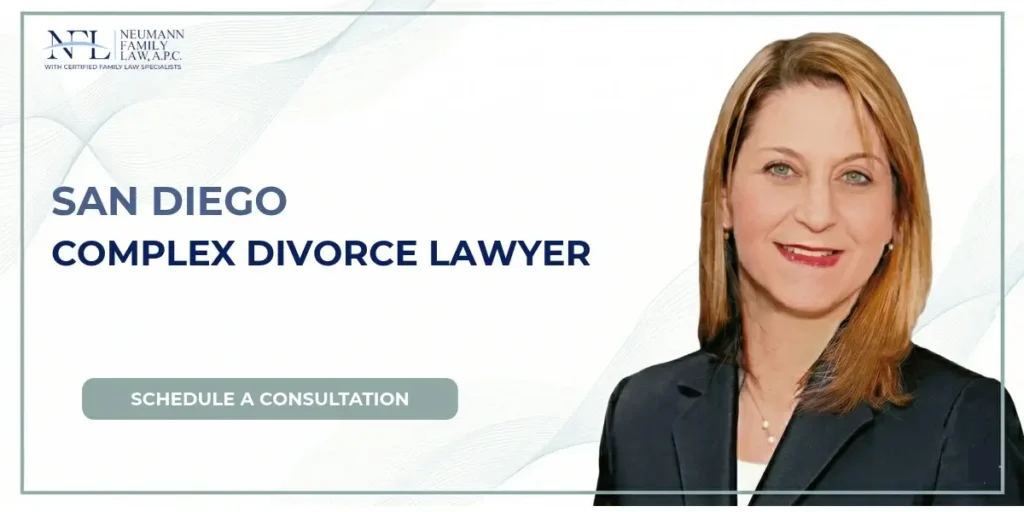
A San Diego complex divorce lawyer at Neumann Family Law, A.P.C. brings that combination to the table. Sara R. Neumann and Edward M. Castro are each Certified Family Law Specialists, certified by the State Bar of California Board of Legal Specialization.
From the first meeting, the goal is to amass a clear picture of what you own, what you are owed, and what a fair outcome actually looks like for your family.
Business Interests, Hidden Assets, and the Other Issues That Make a Divorce Complex in San Diego
When high-assets, business interests, and multiple holdings are at stake, our complex divorce attorneys are prepared to help. Our San Diego legal team regularly handles:
- Valuing and dividing a closely held business or professional practice
- Tracing separate property that has been mixed with community funds over a long marriage
- Dividing stock options, restricted stock units, and executive compensation tied to vesting schedules
- Real estate held across San Diego County and other states, including rental and investment property
- Retirement accounts, pensions, and deferred compensation that often require a qualified domestic relations order
- Cases where one spouse controls the finances and the other suspects undisclosed assets or income
Each of these issues usually needs its own financial expert, whether that is a forensic accountant tracing cash flow or a business appraiser valuing goodwill. Trust interests and distributions require instrument- and fact-specific analysis.
A separate-property trust generally stays separate, but distributions or trusts created during the marriage can raise questions that need instrument-specific and fact-specific review rather than a one-size answer. Getting the valuation and the division assessed the first time matters, because these numbers are difficult and expensive to unwind after judgment.
What You Risk When High-Asset Property Division Goes Wrong?
What happens if a business gets undervalued, or a spouse quietly moves money before disclosure is complete?
Community Property vs. Separate Property
California is a community property state. Property acquired by either spouse during the marriage is presumed to be community property, and each spouse owns half.
Separate property is different. It generally includes what a spouse owned before the marriage, property acquired after the date of separation, gifts and inheritances received during the marriage, and anything a premarital agreement designates as separate.
In a high-asset case, the line between the two is rarely clean, because a business, investment account, or home may have started as separate property and then grown with community funds or effort.
The California Law Behind Equal Division of Community Property
California Family Code section 2550 generally requires the court to divide the community estate equally between the spouses, unless they agree otherwise in writing or on the record in court, or another provision of the Family Code calls for a different result. Only community property is divided this way. Each spouse keeps their own separate property.
Equal refers to overall value, not to each individual asset. One spouse might keep the family home while the other receives retirement accounts, investment holdings, or other property of comparable value, and an equalizing payment can balance any difference.
In a high-asset case, the hard part is rarely the 50/50 rule itself. It is deciding what belongs in the community estate and what each asset is worth, since those two questions drive the final numbers.
What Happens If a Spouse Hides, Transferred, or Mismanages Community Property?
Spouses owe each other a fiduciary duty under California Family Code section 721, which applies to married spouses and requires each to act with the highest good faith toward the other in managing community property. If one spouse hides, transfers, or mismanages community assets, that spouse may be in breach of that duty.
Under Family Code section 1101, the remedy can include an award to the other spouse of 50% of the asset that was undisclosed or wrongly transferred, plus attorney’s fees and costs. Where the conduct amounts to oppression, fraud, or malice, the court can award 100% of the asset.
In a high-asset case, an undervalued business or an unexamined account can be worth far more than a routine dispute, which is why full financial disclosure and analysis should occur before settlement is considered.
How a San Diego Complex Divorce Lawyer at Neumann Family Law Builds Your Case
Building a complex divorce case is methodical work, not a single negotiation session. Here is generally how it unfolds with our team:
- We review your financial picture to identify assets, accounts, business interests, and debts that need to be addressed.
- We bring in any necessary financial experts, such as forensic accountants or business valuators, when the numbers require outside analysis.
- We prepare and exchange the financial disclosures California generally requires in a dissolution, and press for complete answers when something looks incomplete.
- We negotiate after reviewing the disclosures and obtaining any necessary supporting documentation, so any settlement reflects what you actually own rather than a guess.
- We prepare every case as if it may go to trial. Sara Neumann and Edward M. Castro have argued appeals and writs in family court, the kind of appellate experience that shapes how a case is built from day one.
Before moving into complex, high-asset litigation, Sara Neumann and Edward M. Castro spent years in legal advocacy, which gives them a wide view of how financial control and conflict intersect in a marriage. That range matters when a high-asset divorce also involves a contested custody dispute.
Filing at the San Diego Central Courthouse and What It Means for Your Case
Family law matters filed in central San Diego, including divorce cases, are heard at the San Diego Central Courthouse at 1100 Union Street, San Diego, CA
Family law matters filed in north San Diego, including divorce cases, are heard at the San Diego North County Courthouse at 325 South Melrose Drive, Vista, CA
If your case involves a contested custody dispute, the custody piece of a high-asset divorce often moves on a different track than the property piece, and the court’s Family Court Services process may come into play before a judicial officer decides custody.
High-asset clients in San Diego often hold property or business interests in Rancho Santa Fe, La Jolla, Coronado, Del Mar, or the Carmel Valley neighborhood of San Diego, and a home or investment property in any of those areas still has to be identified, valued, and divided under the same community property rules as every other asset in the estate.
Knowing which courthouse handles your filing and which process governs custody versus property helps set realistic expectations for how your case will move.
FAQs About San Diego, CA Complex Divorce Laws
Can a complex divorce actually end in a fair settlement instead of a long trial?
Many do. Complex property issues can often be resolved through negotiation once both sides have accurate valuations and complete financial disclosures, though some cases still require a judge to decide disputed issues at trial.
What is at stake in a high-asset divorce in San Diego?
The outcome often turns on how accurately each asset is identified, characterized, and valued. A business, an investment portfolio, stock compensation, or real estate held in several places can each change the result significantly. That is why the financial work, including valuation, tracing separate property, and forensic review, comes first, before any settlement is discussed.
Where will my complex divorce case be filed in San Diego?
Divorce and domestic violence restraining order matters filed in central San Diego are heard at the San Diego Central Courthouse at 1100 Union Street downtown. North County cases are heard at the San Diego North County Courthouse at 325 South Melrose Drive, Vista, CA.
What does fiduciary duty mean between spouses in a high-asset divorce?
Spouses owe each other a fiduciary duty. In practice, each spouse must act with the highest good faith in managing community property and must disclose financial information honestly. If one spouse locks the other out of a business account, moves large sums, or makes unauthorized trades, the other spouse may have remedies under California law.
How is a business divided in a California divorce?
A business started or grown during the marriage is generally community property subject to equal division, though the portion attributable to separate, premarital effort can sometimes be excluded. A business valuation expert typically determines what the business is worth before it can be divided or offset against other assets.
What if I think my spouse is hiding money or assets?
California law requires spouses to fully disclose their finances during a divorce. If a spouse conceals or improperly transfers a community asset, the court can award the other spouse 50% of that asset, and 100% where the conduct amounts to oppression, fraud, or malice, under California’s fiduciary duty law.
Can my spouse’s income from stock options or bonuses affect support or property division?
Yes. Vested and unvested stock options, bonuses, and other executive compensation earned during the marriage are often part of the community estate and can also factor into support calculations, depending on when they were earned and when they vest.
Will I need a forensic accountant for my case?
Many complex divorces involve a forensic accountant to trace commingled funds, verify income, or identify undisclosed assets. Whether your case needs one depends on how complicated your financial picture is and whether your spouse has been forthcoming with disclosures.
How long does a high-asset divorce typically take in San Diego?
In San Diego, timelines depend heavily on the complexity of the estate. Straightforward matters can resolve faster, while cases involving business valuation, multiple real estate holdings, or contested custody can take considerably longer to work through.
Is my consultation with a divorce attorney confidential?
Yes. Attorney-client privilege applies from your very first conversation with an attorney, and what you share is generally protected from disclosure without your permission. If you have questions about how any of this applies to your situation, our team is ready to talk it through with you.
What Working With a San Diego Complex Divorce Lawyer Looks Like From Here
A complex divorce moves faster and more fairly when the financial picture is accurate from the start.
Neumann Family Law, A.P.C. is a premier San Diego high-asset, complex divorce litigation firm. Sara R. Neumann and Edward M. Castro are each Certified Family Law Specialists, certified by the State Bar of California Board of Legal Specialization, and our team has worked through business valuations, hidden asset disputes, and high-conflict custody matters across San Diego County.
The next step is a direct conversation about what you own, what is at stake, and how to protect it. Contact us today to schedule a complimentary consultation and talk through your situation with our team.
*CFLS = Certified Family Law Specialist by the State Bar of California Board of Legal Specialization