


Whatever your situation, divorce is never easy. There are a multitude of complications and breakdowns in communication that can arise, and emotional challenges can get in the way of a fair and honest process. In San Diego, whether you live in Sunset Cliffs or Carmel Valley, understanding how to file a motion to compel discovery in San Diego divorce cases can prove to be extremely beneficial when you believe your spouse is withholding crucial information.
Types of Divorce Law Discovery Types
In San Diego, a single month can see over 1,000 divorce filings. In these divorce cases, discovery is an important piece of the legal procedure to obtain necessary evidence. When one spouse refuses to cooperate, a motion to compel discovery can come into play. This is a legal request made to the court, urging them to enforce your spouse’s compliance with any discovery requests. There are three main reasons why these motions are filed, including:
- Delay tactics: This happens when one party intentionally tries to delay the divorce process by refusing to cooperate in discovery and thereby withholding evidence or certain forms of documentation.
- Non-compliance: This happens when the opposing party refuses to answer any discovery requests or does not provide correct information.
- Incomplete information: This occurs when the documentation provided by the opposing party is not adequate in helping prove your case.
During the discovery process, various methods can be used to obtain the required information. These include:
- Interrogatories: These are written questions that one spouse can send to the other, requesting a written response.
- Depositions: This is the in-person questioning of the parties or witnesses who may be involved in the case.
- Requests for production: This is a request that can be sent to the opposing party for documents or other such evidence.
When these discovery tools go ignored by the opposing party, you have the right to file a motion to compel. If the courts grant your motion and your spouse still refuses to cooperate, further legal action can be taken.
How to File a Motion to Compel in San Diego
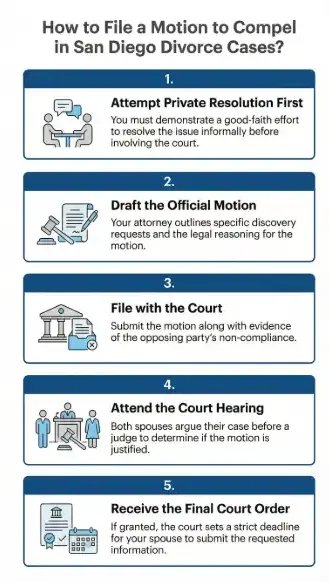
Understanding the steps for filing a motion to compel is vital to your success, all of which can be directed by your attorney. These include:
- Attempt for private resolution: Before you turn to the courts and file your official motion, you need to demonstrate that you tried to resolve the issues privately. This can include an informal discussion or a follow-up request.
- Drafting of the motion: If a private resolution is not successful, your attorney can draft a form motion, outlining your discovery requests, the reasoning behind your motion, and your official discovery requests.
- Filing the motion: You can then submit the motion to the proper court, along with any supporting evidence or documentation showing the opposing party’s non-compliance or refusal.
- Court hearing: A hearing with the court may then be scheduled. Both spouses can use this hearing to argue their case, and the court can then make a decision whether to grant or deny the motion.
- Case outcome: If your motion is granted, the courts may order that your spouse submit the information you’ve requested by a set deadline.
About Neumann Family Law, A.P.C.
With over 25 years of litigation experience, the senior attorneys at Neumann Family Law, A.P.C. are here for you. From La Jolla to Coronado, we are proud to offer comprehensive family law support to our clients. We have Certified Family Law Specialists on our staff and are here to use our knowledge and experience to your advantage in a divorce case.
FAQs
Can I Get Divorced in California Even If My Spouse Doesn’t Agree?
Yes, in California, you can pursue a divorce even if your spouse does not agree, refuses to sign any paperwork, or refuses to participate in the divorce itself. California operates as a no-fault divorce state, meaning that the consent of both parties involved is not required to end the marriage.
What Happens When the Courts Grant the Motion to Compel?
In California, if the courts grant your motion to compel, your spouse may be required to provide whatever discovery you have requested by a set deadline. If your spouse fails to comply with the motion to compel, they can face serious legal consequences and court sanctions. Having a lawyer on your side in this process is crucial.
What Should I Do If I Believe My Spouse Is Hiding Assets?
If you believe your spouse is hiding assets during your divorce process, you need to speak with an attorney. Filing a motion to compel might be the appropriate option to use in this scenario. Nearly 40% of couples across the U.S. have admitted to some sort of financial infidelity, including the hiding of assets during a divorce case.
How Much Does it Cost to Hire a Divorce Lawyer?
The costs involved when it comes to hiring a divorce lawyer can depend on the various factors involved in your case. As each lawyer is different, they may also structure their fees differently, so it is difficult to offer an exact estimate as to how much hiring an attorney may cost. Factors such as the complexity of your case, the duration of your case, and the skill level of your attorney can all play into the final costs involved.
Hire a Divorce Lawyer Serving San Diego Residents
If you believe your spouse is withholding documents or information crucial to your divorce in San Diego, you need to hire a divorce lawyer as soon as possible. Navigating the nuances of divorce is challenging, especially when your spouse is being uncooperative during the discovery phase.
The attorneys at Neumann Family Law, A.P.C. are here to offer you the dedicated and experienced legal support you deserve. We have assisted numerous clients in San Diego and the surrounding areas in their divorce cases, and we are ready to advocate on your behalf, too. Contact us today to schedule a complimentary telephone consultation.
Find more like this: Family Law